



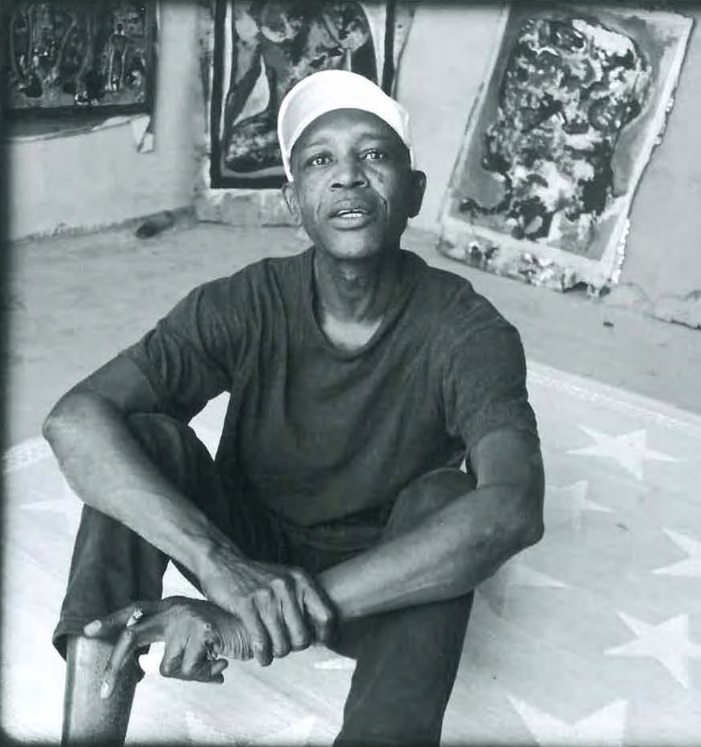
Abdoulaye Guissé lived in Berlin from 1986 to 2003. In 2003 he went back to Senegal and built a cultural center in Kafountine with the Mélentane gallery, where he organized the Mélentane Festival.
In his works, Abdoulaye Guissé is concerned about his environment and his affection for the people without a difference and was surely one of the most committed in his time among the African artists in Berlin. He worked in Berlin among other things in the education work in different projects at schools and other social institutions.
After the great success of the exhibition 'Soleil d'Afrique' in 1994 in the Berlin Galerie Querformat, he participated in many other group exhibitions, among others. with Wolf Vostell and Christo - the artist who concealed the Reichstag - in the Galerie der Berliner Zeitung in 1995.
In 1995 Abdoulaye Guissé participated in the project 'Metronome 3 in Berlin' by Clementine Deliss, which was presented as part of the DOCUMENTA X in Kassel, and in 1997 he participated in the international project 'BACK-GROUND' with 16 European and African artists , The project was realized by QUARTS e.V. Berlin in collaboration with the Goethe-Institut Dakar and the Friedrich Ebert Foundation Dakar within the Dak'Art Biennale.
The work of Abdoulaye Guissé from recent years shows a clear development from the dissolution of the highly figurative forms from the early nineties to the more strongly concretely, more abstract color applications, which only allow the figurative reference. This liberation from the form is partly accompanied by a liberation from the plane, since he sometimes adds a third dimension to his works by adding and integrating "objects" which give the painting an object-like character.
His works are 'African', without the viewer being able to say what is really African about these pictures. Is it the coloring that is often unusual for European eyes, or is it more the recital of an archaic form language, which always recalls?
Abdoulaye Guissé takes his themes from the everyday environment: the encounter with people in the city of Berlin, the confrontation with the traffic of the city, but also the world of a peasant farm in the country - often these impressions are interwoven with the myths of his homeland. He sees the parallels between the worlds and the people of Africa and Europe, placing them at the center of his emotions.